
Goodwood Members’ Meeting 2026 Preview
April 6, 2026
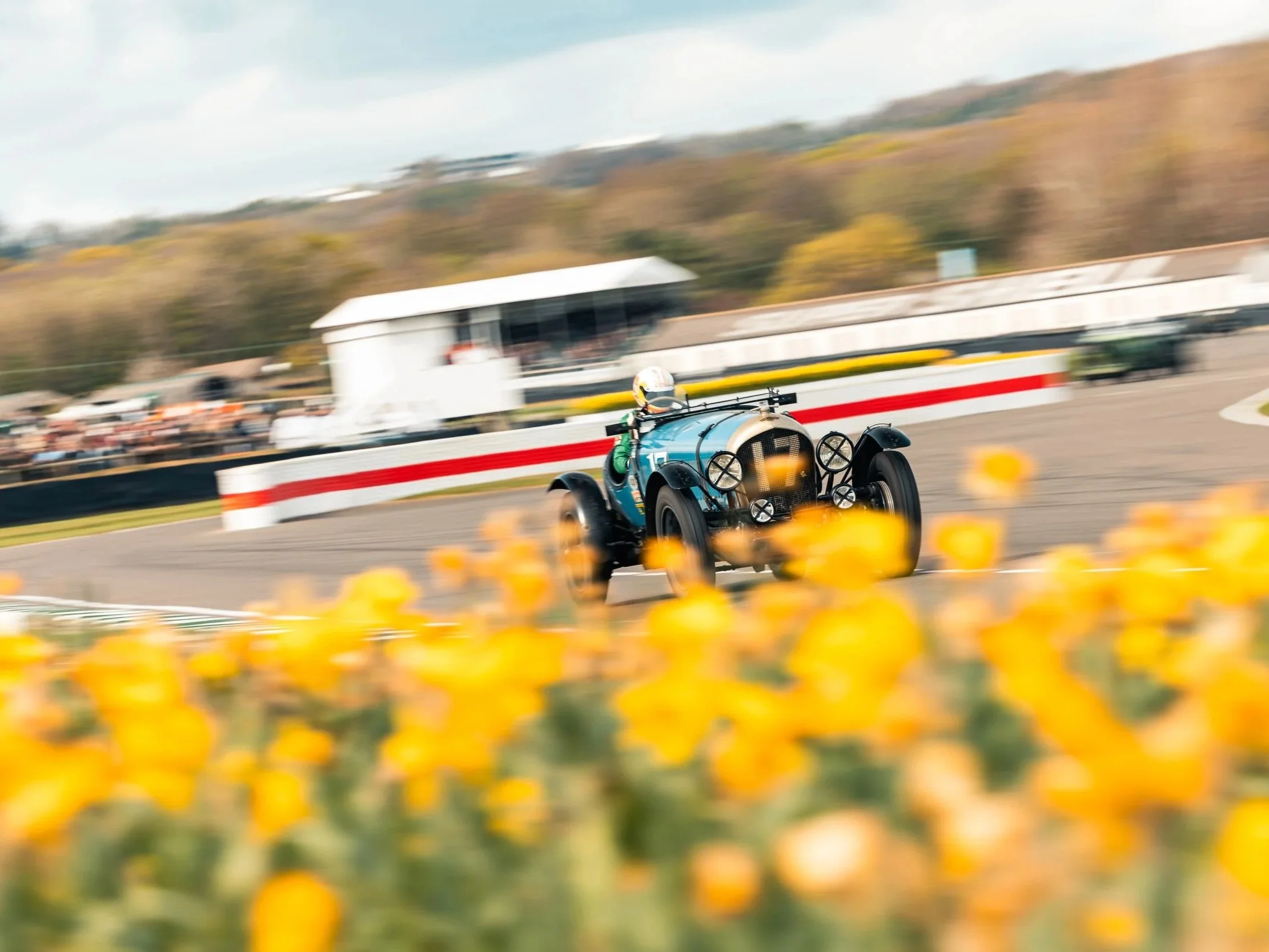
Goodwood’s Members’ Meeting has always been a slightly defiant idea.
It is a race weekend designed around access rather than spectacle, held on a circuit that still looks and feels like a circuit, not a stadium. In 2026, the 83rd Members’ Meeting returns on 18 and 19 April, presented by Audrain Motorsport.
To understand why it matters, you have to start with what Goodwood is, and what it has chosen not to become.
The Motor Circuit opened its gates in September 1948 to host Britain’s first post-war motor race meeting at a permanent venue. Goodwood still describes it as the only classic circuit to remain entirely in its original form. It sits on the outline of a former wartime airfield and, unlike many heritage venues, it has never needed to manufacture a sense of place. It is already there in the perimeter roads, the geometry of the corners, and the sheer closeness of the action.
The Members’ Meetings themselves began in period as events for BARC members, deliberately not promoted to the general public, and shaped by the idea that club racing should be for the club. Goodwood’s own archive on the event notes that 71 Members’ Meetings were held between 1949 and 1966, before the modern-era revival began in 2014 with the 72nd Members’ Meeting.
That continuity is not just a charming footnote. It is the point.
A meeting built on intimacy, not scale
Goodwood’s current description of the Members’ Meeting is blunt about what it is selling: an “intimate, uncrowded atmosphere” with open access to paddocks, cars and drivers, available only to GRRC members and Fellows.
The GRRC itself was established in 1998 by the Duke of Richmond, originally as the membership backbone around Goodwood’s modern motorsport programme. That same programme now sits inside a wider Goodwood economy that has been analysed as a kind of luxury experience business, built around live events and a globally recognisable aesthetic.
For brand owners and partners, the implications are straightforward. Members’ Meeting is not trying to be the biggest. It is trying to be the closest. That attracts a particular kind of audience: people who do not just watch cars, but stay with them, collect them, maintain them, and buy into the culture around them.
That distinction matters more each year, because historic motorsport is no longer a niche that survives on nostalgia alone. It is an expanding category of sport and lifestyle, with growing international attendance at comparable flagship events and a widening commercial footprint across media, merchandise and hospitality.
(We summarised this broader growth trend in our historic motorsport market work. )
What Goodwood has confirmed for 2026
Goodwood has published a confirmed race list for the 83rd Members’ Meeting, including two new races for 2026, and the return of several well-established Members’ Meeting staples.
A few details are especially worth noting.
All races at the 83rd Members’ Meeting are set to run on sustainable fuel, with competitors required to use a blend containing at least 70 percent advanced sustainable components. This is a significant signal from a heritage event that has historically traded on the sensory language of older machinery.
The Protheroe Cup is new for 2026 and is positioned by Goodwood as a 65th anniversary marker for the Jaguar E-type, bringing together pre-1963 racing E-types in a two-driver format. The Phil Hill Cup is also new, and Goodwood describes it as drawing inspiration from mid-1960s American sportscar racing.
Among the returning fixtures, the Bruce McLaren Trophy is coming back after last being held at Goodwood in 2016, with Goodwood describing it as a likely fastest race of the event, centred on pre-1967 Can-Am and Group 7 cars. The Peter Collins Trophy also returns after a hiatus, for sportscars and production sports-racing cars that competed between 1950 and 1955.
The two-wheeled strand remains an essential part of the Members’ Meeting character. The Hailwood Trophy (featuring the Sheene Trophy) returns as the event’s motorcycle race, run across two parts.
Alongside the racing, Goodwood has already announced several demonstrations and celebrations that will shape the weekend’s cultural centre of gravity.
The James Hunt Years
Goodwood will celebrate James Hunt at the 83rd Members’ Meeting, tied to the 50th anniversary of his 1976 F1 World Championship, with a demonstration featuring a collection of Formula 1 cars from the 1973 to 1979 period.
Barry Sheene, across the entire calendar
Goodwood has also said it will commemorate the 50th anniversary of Barry Sheene’s first 500cc World Championship victory across all three major Goodwood motorsport events in 2026, beginning at Members’ Meeting. It will include the first-ever Members’ Meeting motorcycle demonstration, showcasing “The Sheene Years” with 20 to 30 Grand Prix bikes from the era of Sheene’s 500cc career (1974 to 1984).
Super Touring as a modern heritage category
Goodwood’s press material also confirms a Super Touring Car demonstration and Shoot-Out, with Goodwood stating it expects over 40 Super Touring cars across static and dynamic displays, and a competitive Shoot-Out element across the weekend.
Jenson Button: modern icons used sparingly
Finally, Goodwood has announced that Jenson Button will reunite with his title-winning Brawn GP car for a demonstration, and will also compete in the Gordon Spice Trophy in a Chevrolet Camaro Z28 alongside Andrew Smith.
Goodwood notes that the published schedule is provisional and subject to change, with full timetables and entry lists typically confirmed closer to the event.
Why this matters beyond the circuit
If you are only there for the racing, the Members’ Meeting works exactly as intended: the paddocks are open, the field is eclectic, and the circuit rewards commitment. But if you work in licensing, partnerships, or heritage brand-building, it is also a compressed view of where the category is heading.
Three themes feel especially clear in 2026.
1) Heritage is now programmed, not simply preserved
Goodwood is not just running historic grids. It is curating eras, anniversaries, and storylines, then building product, media and on-site experiences around them. The James Hunt and Barry Sheene celebrations are not background colour. They are the editorial spine of the event.
This is the modern heritage model: story first, then assets, then experiences.
It is also visible in how quickly Goodwood turns those narratives into physical goods. The Goodwood Shop publishes a dedicated Members’ Meeting collection and positions the event explicitly as an “epic weekend” built to recreate the atmosphere of the original BARC Members’ Meetings.
That matters because, in licensing terms, it is a reminder that the strongest programmes are not built on marks alone. They are built on usable history.
(That principle sits at the centre of how we talk about licensing internally: legacy before logos. )
2) Brand partnerships are increasingly “membership to membership”
Audrain Motorsport is not just a sponsor name on a graphic. Goodwood’s own announcement frames the relationship as an alignment between two membership-led automotive cultures, linking the Audrain Museum and Audrain’s event ecosystem with the GRRC and Members’ Meeting.
This is a particular kind of partnership: less mass exposure, more affinity. Less interruption, more belonging.
In an increasingly crowded motorsport partnership market, this is one reason heritage platforms continue to attract high-quality partners. They offer a concentrated audience with time, attention, and intent.
3) The sustainability question is now inside the heritage tent
The sustainable fuel requirement at Members’ Meeting 2026 is easy to dismiss as a technical rule, but it is more consequential than that.
It suggests that even the most tradition-heavy corners of motorsport are working out how to defend the cultural right to exist, without losing authenticity. For partnerships and licensing, this changes the brief. It pushes product development towards materials, provenance, durability and credibility, not just aesthetics.
Where licensing actually fits at Members’ Meeting
Licensing can feel abstract when it is discussed in boardrooms. Goodwood is useful because it turns the subject physical.
You can see the raw material in one glance: cars that still carry meaning, eras that still have fans, and owners who care about accuracy. You can also see the commercial translation happening in real time: apparel, prints, books, collectables, and event-branded goods moving through a weekend that never feels like a trade show.
Our own category view of motorsport licensing tends to cluster around a few proven pillars: collectables and models, apparel and accessories, publishing and media, watches and lifestyle goods, plus the fast-growing edge of gaming and sim racing.
Goodwood is not the only place where those categories sell, but it is one of the few places where they can be tested against a live, knowledgeable audience, with the brand owners and historians often standing a few metres away.
That is why the Members’ Meeting matters as a business environment. It is not a mass market. It is a credibility market.
Apex at Goodwood
Apex Licensing will be attending the 83rd Members’ Meeting.
If you are a rights holder thinking about how to protect and extend a heritage brand, or a potential partner looking for a programme built on fit, not noise, we would welcome a conversation trackside.
Our work is built around a simple sequence: understand the IP properly, position it with restraint, then take it to market with partners who add value rather than dilute it.
If you would like to meet at Goodwood, contact us here.
